Clinical software that can grow with AI.
Breeze EHR is a complete electronic health record for medical practices, built on the FHIR standard from the start and evolving on an open health platform made for deeper integration.
Your clinical software needs to let useful tools take part in daily work: preparing the next step, contributing a draft, updating an appointment, following a task through to completion. The platform underneath the EHR decides how deeply those tools can help. Breeze is opening that foundation. It runs on desktop, tablet and phone, and is delivered as a hosted service.
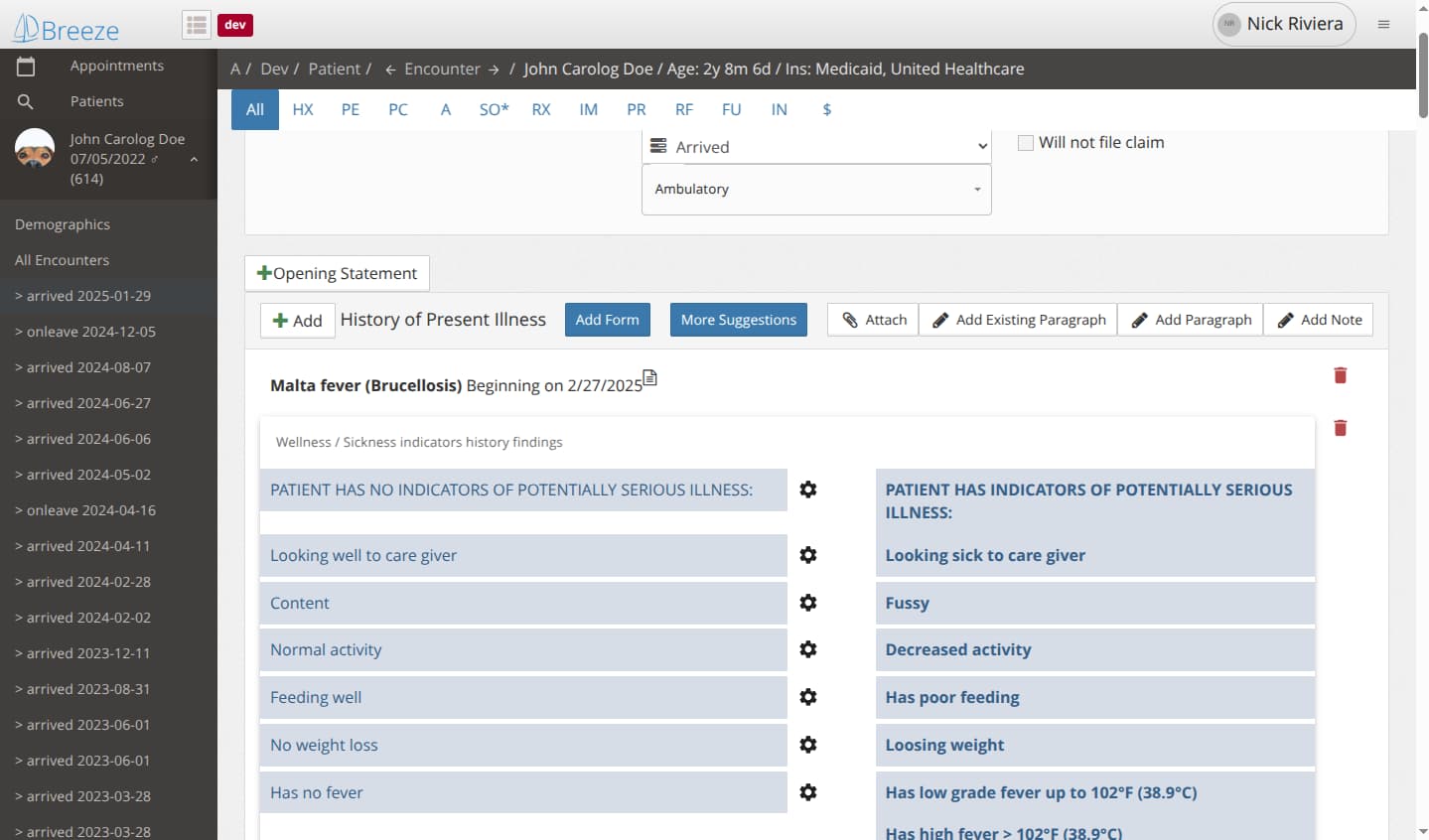
Everything a practice does in a day, on one record.
Charting, ordering, results, prescribing, scheduling, tasks, referrals, claims and patient access, all on one FHIR record that keeps its full history.
Charting
Structured findings and free text in the same note, with the history, exam, assessment and plan where clinicians expect them.
Suggestions as you write
Decision support appears inline while the note is written, from rules the practice can read and review.
Orders and results
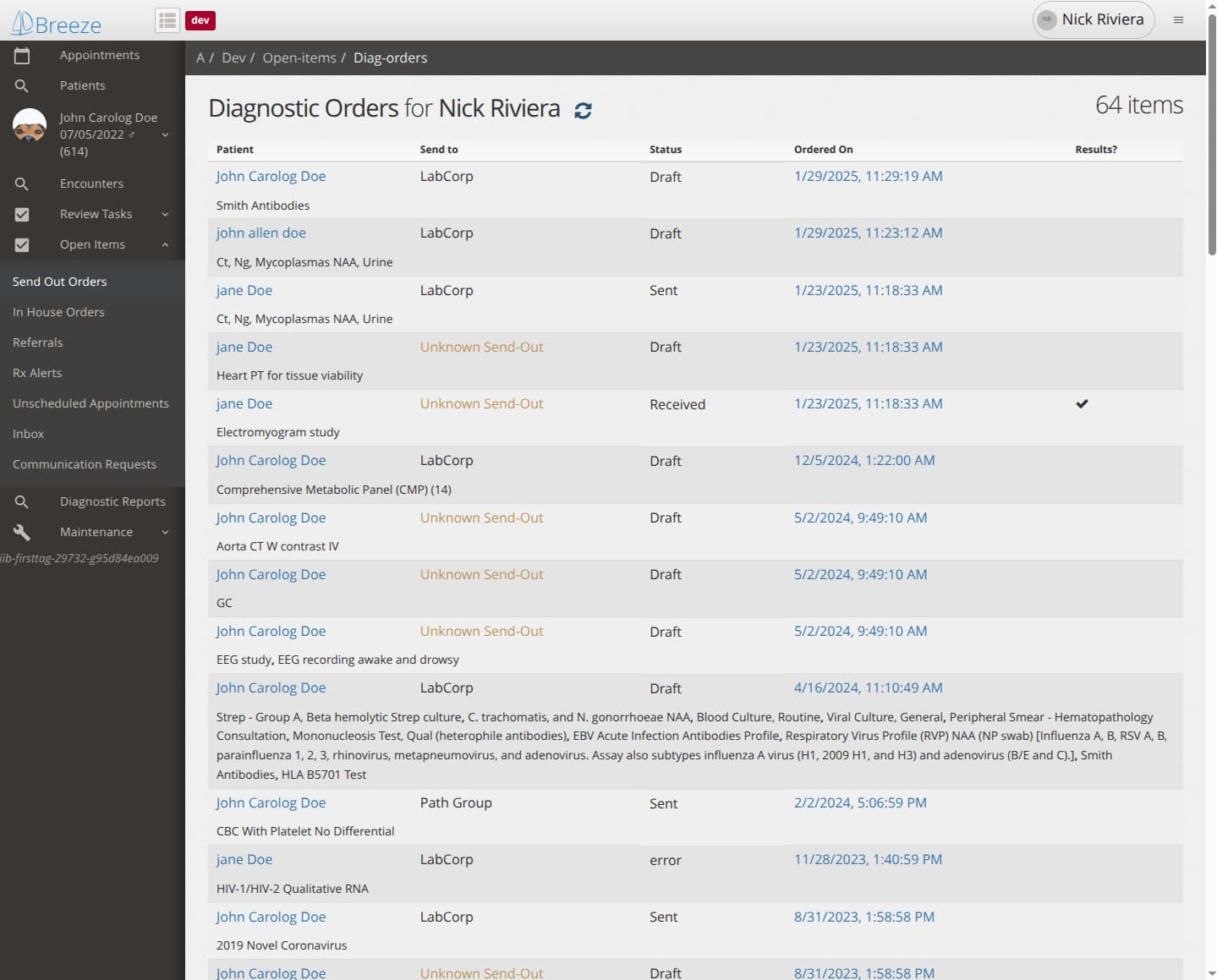
Lab orders sent electronically, in-house and send-out orders tracked from draft to result, with results landing in the chart.
Prescribing
Electronic prescribing, renewals and medication history through the national e-prescribing network.
Scheduling
Book, reschedule, check in and mark no-shows; a day's schedule copied to another day in one step.
Tasks and review
Results, messages and referrals routed as tasks with an owner, so nothing waits in an inbox unowned.
Referrals and claims
Referrals created with the reason attached; claims filed from the visit.
Patient portal
Patients see their record, appointments and messages, and can propose changes to their details for staff review.
Pediatrics
Growth charts and immunization records, reported to the state registry.
Phone and tablet
The whole record on a phone or a tablet, laid out for the screen, so rounds, home visits and on-call questions do not wait for a desk.
Fax and documents
Faxes and scanned documents come into the chart, matched to the patient and routed to the right person's queue; faxes go out from the chart too.
Hosted for you
Delivered as a service: Breeze runs the platform, each practice has its own separate space on it, and updates arrive with nothing to install.
Reach the clinician while the patient is in the room.
Decision support in Breeze is how an organization reaches its clinicians at the one moment that changes care: while they are in the room with the patient, writing the note, still deciding. Not a memo, not a meeting, not a message waiting in an inbox afterwards.
A rule is a readable statement of the group's own judgment: if the patient is this age and has not had this vaccine and the note says this, show this. It runs in milliseconds, inline, in the section of the note the clinician is working in. It is the closest thing to having your medical director in every exam room at once, and it is how a protocol the board agreed on actually reaches every provider at every location.
Informing, not interrupting. Most decision support waits for the clinician to act and then objects: a pop-up when the order is signed, a task in the inbox after the visit. People learn to click past those. Suggestions that arrive while the note is being written are part of the thinking rather than an obstacle to it, which is what makes them educational rather than something to dismiss.
The same answer every time, with a reason. The same record produces the same suggestions, for every clinician, every time, from rules anyone can read. A model can answer differently tomorrow and cannot fully explain why; a rule can always be pointed at.
Language models have their place too: reading a long history, drafting, summarizing, answering a question nobody wrote a rule for. Think of it this way: a rule is where the practice's judgment lives, and a model is where the labor gets done. A model can draft; rules keep watch. Both are being built into daily work on the same platform, under the same permissions, with a person reviewing what a model proposes.
Your clinical leadership owns the rules. Rules are data, not code: your medical director can read them, argue about them, change them, and publish the change to everyone at once, without waiting for a software release. A new rule editor, now in design, will let clinicians write a rule the way they would say it, as a sentence with blanks, and author the suggested items with the same editors they use during a visit.
Integration with the work your team does.
The platform underneath Breeze EHR already exposes appointment booking and rescheduling, task transitions with their rules, referral creation, terminology tools, collaborative notes, and updates that follow changes in the record, as documented interfaces other software can use.
Permissions and workflow rules are enforced by the system, not by each tool. That is the concrete foundation for AI assistance inside clinical workflows. A complete assistant must also respect who may act, obtain review where needed, and leave a clear account of its work. We are continuing to develop and prove those complete workflows.
More choice as your tools evolve.
Our direction is an open platform that lets your organization choose and change the software working with its clinical systems, including choices about AI, extensions, and who operates the platform.
Today Breeze EHR is delivered as a hosted service: Breeze operates the platform, each practice has its own separate space on it, and updates reach every practice at once with nothing to install. We will make the wider choices concrete through published interfaces and explicit release terms. The core server is open source; Breeze-specific clinical definitions are currently proprietary, and the complete platform is not yet offered as an independently deployable package. A demonstration shows which workflows are available in the offered deployment and which integrations are still being developed.
A small team from Louisiana.
Breeze was founded by Dr. Jibran Atwi, a physician who wanted an EHR that takes part in the diagnostic process instead of only recording it. The record has been built on FHIR, the healthcare data standard, from the start, so that each part of the system can be extended or replaced without starting over.